News

News

Quality, Speed and AI: What Insights Leaders Told Us at Quirk’s New York

Three subjects dominated our booth conversations at the Javits Center. The more we heard, the clearer it became that they’re tangled together rather than ranked against each other. 

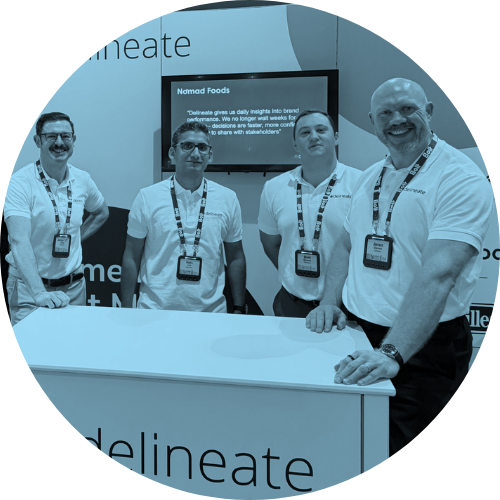
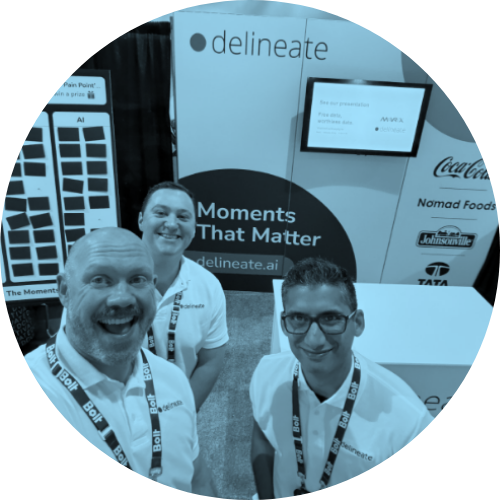
The Delineate team spent July 29–30 at the Javits Center for The Quirk’s Event – New York, joining researchers, insight leaders and industry partners for two days of sessions, conversations and networking. Alongside the conference program, the event included a busy expo hall and an opening-night karaoke party, which Delineate was pleased to sponsor. 

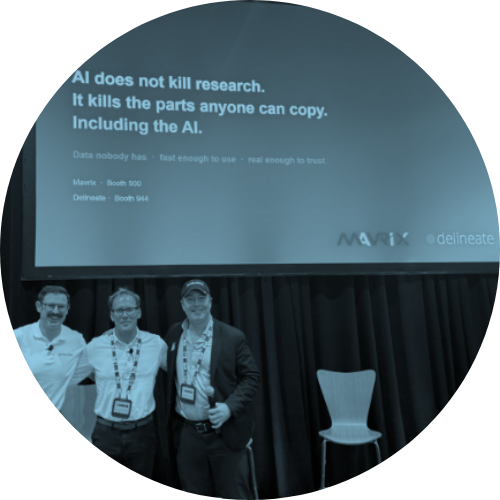
Delineate Founder and CEO James “JT” Turner also joined Glen Collins and Rafal Gajdamowicz of MAVRIX for Free data, worthless data: What’s actually left worth paying for? The session explored what retains its value as AI makes more of the research process cheaper and easier to automate, and why the answer lies in data that is proprietary, real-time and defensible. 

Across the two days, three topics kept coming up at booth #944: quality, speed and AI. None of these is new to anyone who buys or runs research, but the conversations showed how expectations around each one are changing. 

They’re also the three pain points we hear most often from clients. So, we asked visitors which one is creating the greatest challenge for insight teams right now. Researchers and analytics leaders stopped to make their choice and tell us why. 

Speed and quality came through most often. But the conversations quickly showed that these weren’t separate problems. Teams need answers faster, without losing confidence in the quality of the data or the depth of the insight. 

AI was selected less often than we’d expected, but it was still present in almost every conversation, either as a way to work faster or as another reason to pay closer attention to quality.
Quirks 1    Quirks 2     Quirks 3

The two sides of quality


Quality came up most often and turned out to have two quite different sides. 

The first was respondent quality. With consumer data informing increasingly visible and important decisions, poor-quality respondents do more than add noise. They create more questions than answers and weaken trust in the findings, the provider behind them and, ultimately, the value of the investment. 

The second side was the depth of the insight. For many of the researchers we spoke to, this was the greater frustration. Several described paying significant sums for a headline number on an executive scorecard, or for a set of topline metrics with little context around them. The number may be sound, but it doesn’t show what moved, why it changed or what the business should do next. 

That leaves the internal insight team to piece together the story themselves, often using separate studies or secondary data sources that weren’t designed to answer the same question. That’s where the work starts to become fragmented and difficult to defend. 

Quality, in that sense, means more than a clean sample or a reliable metric. It means having enough depth and context to explain the movement, understand what’s driving it and support the next decision. 

The speed problem


The pressure to move faster was just as consistent, but the frustration was more specific than simply wanting a quicker turnaround. 

Research teams are fielding more requests, from more stakeholders, against shorter decision windows. Yet many are still working with studies run at fixed points in the quarter or year, followed by reporting cycles that add further delay. 

A wave like that gives teams a useful snapshot, but it isn’t the same as tracking change as it happens. By the time the findings arrive, the moment they describe may already have passed. The frustration was that fixed research cycles and reporting delays meant findings often arrived after the business had already needed to act. 

That’s why speed and quality never really came apart in these conversations. A fast answer that can’t be trusted is of little value. A reliable answer that arrives after the decision has been made may be equally difficult to use. 

The real requirement isn’t simply faster research. It’s reliable data delivered in time to influence the decision. 

Where AI fits


AI ran through the event, as it has through almost every industry gathering this year, but it was selected less often than quality or speed at our booth. 

That doesn’t mean it matters less. It suggests the conversation is changing. The question is no longer simply whether AI will replace the researcher. Insight teams are now working out where it genuinely helps, where it introduces risk and how to use it without lowering their standards. 

Many of the leaders we spoke to are under pressure to use AI, whether that direction comes from within their team or from senior stakeholders. Their challenge is to find applications that make the work faster and more efficient while protecting the quality of the evidence and the value they bring to the organization. 

That is also why AI never really stood apart from speed and quality. It runs through both. It can help teams process and access information faster, but the output is only as reliable as the data behind it. At the same time, the technology making data generation cheaper is also making it harder to separate genuine respondents from synthetic ones. 

There is also a difference between having data and having data that is ready to work with AI. 

Dropping an unstructured file into a general-purpose model and hoping it interprets every metric correctly is not enough. AI-ready data needs to be clean, structured and delivered in a format that can be reliably ingested by an organization’s own models and agents. The clearer the parameters around how that data can be used, the more confidence teams can have in what comes back.  

Trust sits underneath all three


One thread tied a lot of these conversations together, and it came up more insistently in New York than it had at Chicago or Dallas earlier in the year: trust. 

Brands need to trust the quality of the data they’re given, the timelines they’re promised and, increasingly, the claims being made about AI capabilities and roadmaps. 

That matters even more when research budgets are under closer scrutiny. Insight teams often have to defend every purchase internally, which means providers need to deliver what they’ve promised and show why the evidence can be trusted. 

Long-standing agency relationships still carry weight, particularly when established metrics sit on executive scorecards and continuity matters. But reputation alone isn’t always enough. We heard buyers questioning whether established approaches are keeping pace with what the business now needs and whether promises around innovation, AI and delivery match what actually arrives. 

When the promise and the reality begin to separate, people start asking harder questions. 

Trust, then, isn’t a fourth issue sitting beside quality, speed and AI. It’s what determines whether any of the three delivers real value.  


What we took away from New York


These conclusions didn’t come from a trend deck or a forecast about where the category is heading. They came from standing at a booth for two days and asking the people who are actually buying and running research what’s making their jobs harder. 

The more we heard, the harder quality, speed and AI were to separate. Speed only matters when the evidence behind it can be trusted. Quality means not only knowing that a number is sound, but also understanding why it moved and what to do next. AI earns its place when it has clean, structured and defensible data to work with. 

The providers that stand out over the next few years will be those that can deliver on all three at once: fast enough to act on, solid enough to defend when the budget gets questioned, and based on evidence that others can’t simply reproduce. 

That’s what Delineate Proximity® is built for: always-on brand and campaign tracking that gives teams fast access to real consumer data, backed by the quality controls and depth needed to act with confidence, and designed to work with the modern insight stack rather than fighting it. 

If quality, speed and AI are live questions for your team too, we’d be glad to carry on the conversation – Get in touch with us today.  

Join our Newsletter