Your leaders want AI to grow the business. Insights teams are still mostly pitching it as a way to work faster and cheaper, and new research with over 400 brand-side leaders shows why that puts insights at risk.
AI has reached most insights teams. Around three-quarters of research buyers have started using it in their insight work, largely to analyze faster, report sooner, and get more from the same team.
That is a sensible place to start, and it is where most insights teams still are, but the C-suite wants more. In the Delineate Brand Insights Study 2026, leaders named growing the business as a goal for AI almost as often as productivity, and far more often than insights professionals did. The gap already shows in how leadership sees the function: 35% of C-suite leaders who oversee research believe AI tools could perform the role of the insights function.
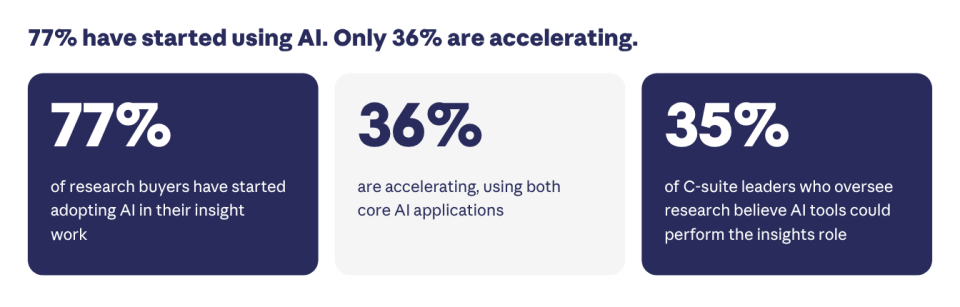
(Source: Delineate Brand Insights Study 2026)
The teams in the strongest position use AI to help the business grow, and to save time as well. We call them AI Accelerators, and what they do differently is open to any insights team.
Where leadership and insights disagree on AI
The C-suite has good reason to want more than efficiency. McKinsey’s State of AI in 2025 found that 80% of organizations set efficiency as an objective for AI, and that those getting the most value from it set growth and innovation objectives too. BCG finds that the 5% of companies it calls “future-built” achieve 1.7 times the revenue growth of AI laggards. In PwC’s 29th Global CEO Survey, only one in eight CEOs say AI has delivered both lower costs and higher revenue. Efficiency is where AI starts, and the value comes when it is used to grow.
Insights teams have not caught up with that yet. Both groups want AI to make the insights team more productive. They part company on growth, and the gap is widest on the goals that matter most to the business: growing revenue and generating new ideas.
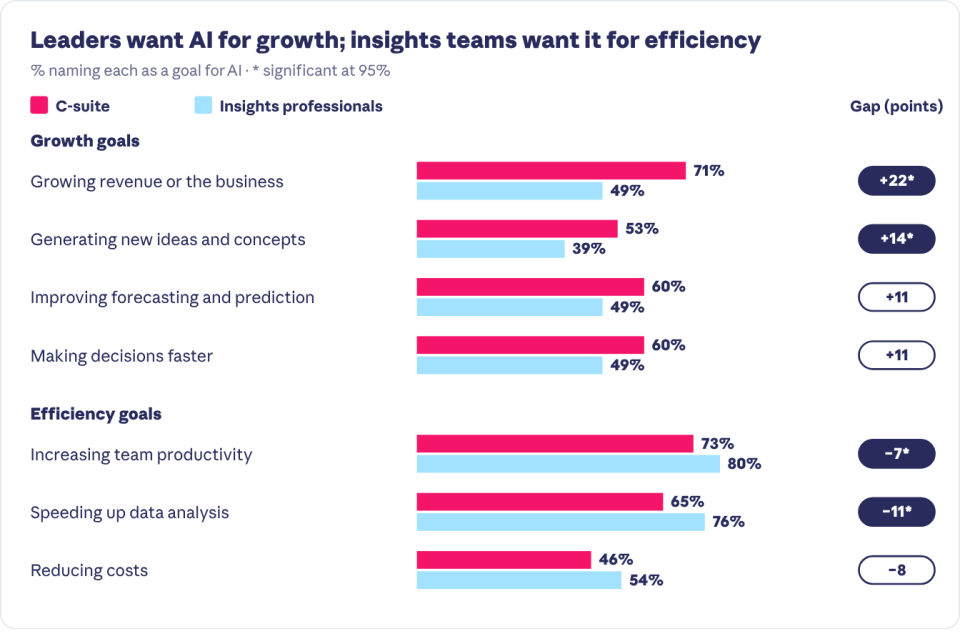
(Source: Brand Insights Study (BIS) 2026, Delineate)
Cost cutting barely separates the two groups. The divide is growth. More than half of C-suite leaders (56%) name growth and productivity together, while 39% of insights professionals name efficiency with no growth goal at all.
Efficiency is the easier case to make. It can be counted in hours, and it sits inside the team’s control. Growth depends on decisions other people make, which is also why it puts the insights team closer to the decisions that matter.
Leaders are further along with AI than many of their insights teams, too. 51% of C-suite respondents are Accelerators, against 31% of insights professionals, so the people judging what insights is worth are often more advanced with AI than the team they are judging. Marketing feels the disconnect as well, as the function most likely to see insights as a support function. Data science is the exception: two in three data scientists see insights as a strategic partner.
The stakes are real.
The C-suite is not cutting research. Among leaders who oversee it, 93% rate their insights team good or very good, and 37% expect research budgets to rise by 10% or more next year. The money is there. The question is whether it comes to insights.
Where company growth has stalled, insights is already being left out. In companies with flat or declining revenue, only 39% say their insights team is very important to the company’s AI strategy, against 66% in growing companies.
An insights team that pitches AI only as a way to do the same work for less is making the case for its own replacement.
Liubov Ruchinskaya, founder of Insights Lighthouse, put the same challenge in the Adapt or Be Cut episode of the Research Revolutionaries podcast. As AI changes the rules of research, she argues, insights professionals have to move beyond data delivery into positions of influence, judgment and leadership.
The AI Accelerators are becoming the growth partner
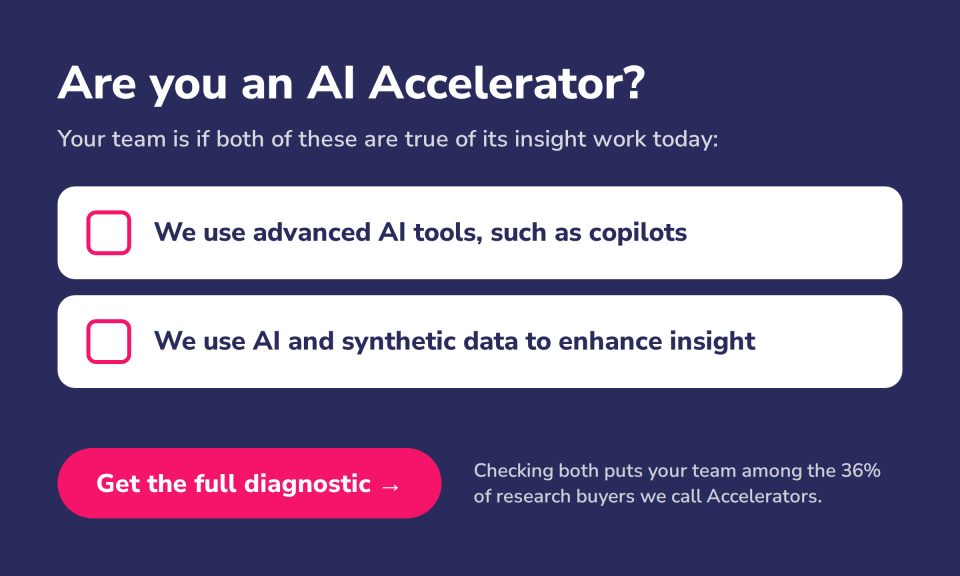
Accelerators are research buyers whose day-to-day insight work already uses both core AI applications: advanced AI tools such as copilots, and AI and synthetic data to enhance insight. Teams first adopt AI, then accelerate, and around a third of buyers have made that step. Everyone else we call Traditionalists.
What sets Accelerators apart is what they use AI for. They keep the efficiency goals and add growth ones, and where they are, insights look much more like the growth partner the C-suite is asking for.
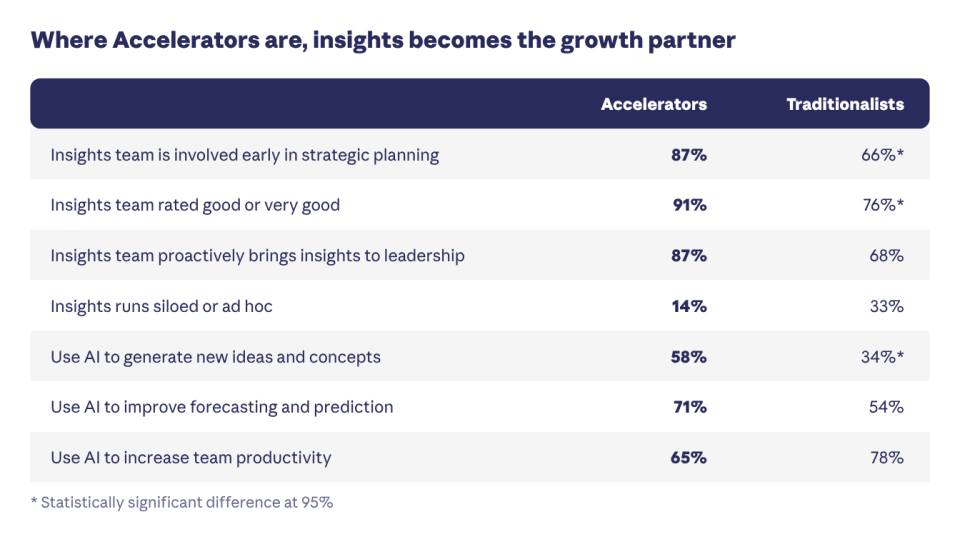
(Source: Brand Insights Study (BIS) 2026, Delineate)
Their insights teams are brought into strategy earlier and rated more highly, and they use AI to generate ideas and sharpen forecasts as well as to save time. That is the case the C-suite is waiting to hear.
What Accelerators do differently
The biggest differences are in practices any insights team can adopt, and three stand out.
Using the research they already have: 89% of Accelerators use AI to synthesize insight across studies and sources, against 42% of Traditionalists. It is the widest gap in the research, and it needs no new fieldwork.
Checking what AI tells them: 78% validate AI outputs against real-world data, against 50%. Traditionalists are more worried about AI accuracy but less likely to check it, so the Accelerators’ confidence comes from the checking.
The check is only as good as the data behind it, which is why 73% of Accelerators rate data quality and fraud detection as very important, against 54% of Traditionalists. We have looked at how natural and synthetic samples compare on data quality in more detail.
Being open about how AI is used: 88% have transparency and ethical-use practices for AI, against 48%.
In practice this can be simple. An AI tool explains why consideration dipped in one market last month. Before that goes to the CMO, the insights team checks it against the tracker and sends both: the finding, and a line on what it was checked against and how it held up. The conversation can then move straight to what to do about it. Delineate Proximity® sends tracking data into the BI and AI tools clients already use, so the check can happen where the work is done.
What really predicts becoming an AI Accelerator
The obvious guesses about who the Accelerators are turn out to be wrong. Age, seniority, role, personal enthusiasm for AI, country and company size do not independently predict it. Breadth of research does.
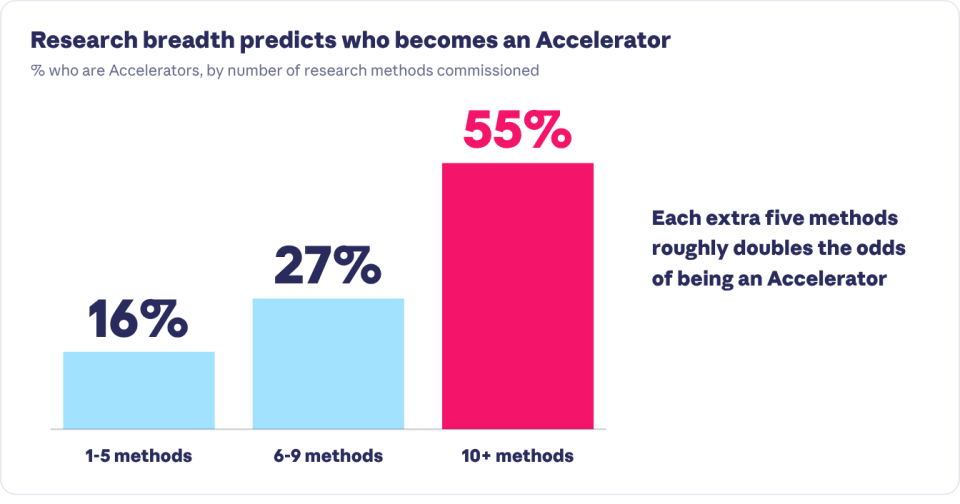
(Source: Brand Insights Study (BIS) 2026, Delineate)
Breadth creates both the need and the raw material, with more studies to connect and more real data to check AI against.
It also explains what looks like a seniority effect. Mid-level managers who run a broad range of research are nearly as likely to be Accelerators as senior managers with the same breadth, and around five times as likely as mid-level managers with a narrow one. The gap between junior and senior is a gap in exposure, and breadth is within reach.
Making the growth case to leadership
Becoming an Accelerator runs through practices your team already controls, with no new supplier or new hire required. The white paper sets out seven moves, and three of them are a place to start this quarter.
1.Make the growth case
Frame what AI does for your research by what it adds: new ideas, better forecasts, faster decisions. Reinvest the efficiency gains where the C-suite can see them. The next update to leadership should lead with what AI helped the team find or forecast, with the hours saved second.
2. Start with the studies you already own
Synthesis across existing research is the widest gap between Accelerators and Traditionalists, at 47 points, and the quickest to close because it needs no new fieldwork.
3. Make validation routine
Validation is what turns the C-suite’s confidence in your team into confidence in AI-driven insight. Decide in advance when a person reviews an AI output, and show leaders what each finding was checked against.
The other four moves, from getting into the room earlier to building alliances with data science and marketing, are in the white paper, along with five steps for validating AI outputs so leaders trust them.
Where does your team sit?
The 35% of C-suite leaders who think AI could do the insights job are telling insights teams which case they have not yet heard. Accelerators are already making it, and none of what they do depends on age, title or enthusiasm for AI.
The white paper shows where your team sits, with the full two-minute AI Accelerator diagnostic. Alongside it sit the full findings by role, the C-suite’s view of AI set against everyone else’s, all seven moves, the five validation steps and the method behind every figure.
Don’t leave the choice between AI acceleration and replacement to someone else.
Download the white paper: Accelerate or Be Replaced? Why Insights Teams Must Use AI for Growth
About the research. For the Delineate Brand Insights Study 2026, we surveyed over 400 brand-side C-suite, insights, marketing and data science leaders at B2C companies with revenue above $50M, in the US and UK. The survey ran online through four B2B research panels, with the extended questionnaire (189 respondents) fielded September 25 to October 1, 2026, and the data are weighted to a validated profile.