Blog

Blog

Adapt or Be Cut: How Insights Teams Can Protect Their Relevance

Synthetic data is not hard to generate. It is hard to know when to trust. 

Insights teams are being asked to prove their value at the same moment AI is making much of their visible output faster and cheaper to produce. 

Research design, analysis and reporting are accelerating, while budgets remain under pressure. Senior leaders are questioning whether work that once took weeks should now take days, or whether some of it needs to be done at all. 

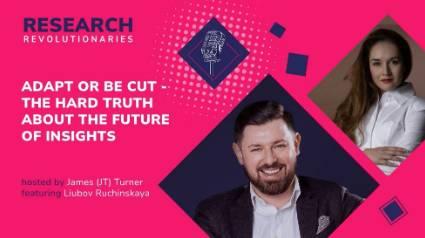
In episode 15 of Research Revolutionaries, Delineate founder and CEO James “JT” Turner spoke with Liubov Ruchinskaya, founder of Insights Lighthouse, about what this means for the function. Liubov believes as much as 40% of the industry could become redundant within the next 18 months. 

The exact figure is her prediction, but the vulnerability behind it is real. When companies are trying to move faster with fewer resources, teams whose contribution ends with delivering data and explaining what has already happened become easier to question. 

Good research still matters. But when it doesn’t change what the business does, its value becomes much harder to defend. 

You can watch or listen to the full podcast episode here: https://www.research-revolutionaries.com/adapt-or-be-cut-the-hard-truth-about-the-future-of-insights/  

Adapt or Be Cut How Insights Teams Can Protect Their Relevance

Useful Isn’t the Same as Influential


“My brutal answer is that I do not see much change,” said Liubov when asked how much the industry had changed over the past decade. 

Her concern wasn’t that insights teams are producing poor work. It was that many are still treated as contributors or data providers, brought in after someone else has already decided what needs to be researched and often expected to leave once the findings have been presented. 

The process is familiar. A brief arrives, the team commissions the work, reviews the results and prepares the presentation. In some cases, that can amount to taking a supplier’s report, refining it and passing it on, even though the most important debate may already have taken place before the research began. 

When insights isn’t involved in framing the problem, it can end up answering the question it was given without ever testing whether it was the right one. And when the team’s role ends with the presentation, it may have little visibility into how the evidence was interpreted, whether it changed the recommendation or what the business eventually decided to do. 

That makes the value of the function easy to underestimate. The cost of research is visible, as are the people involved and the time taken to deliver it. Influence is harder to trace, particularly when the contribution was preventing a weak idea from progressing, challenging an assumption or giving the business a reason to pause. 

Strong methodology remains essential, but it won’t protect a function whose influence is difficult to see. Insights teams need a clearer link between the evidence they produce, the choice in front of the business and what happened next. 

They don’t need to own the final decision, but they do need to be close enough to shape it.

The Report Is Only the Beginning


Shaping the decision means doing more than reporting what the research found. Most research starts with something that has already happened: a tracker shows how perceptions have moved, campaign measurement captures a response to activity, and customer research reflects experiences people have already had. 

As Liubov put it, “The most important thing is what happens tomorrow, not only what happened in the past.” A fall in consideration may be important, but the number alone won’t tell the business whether it’s temporary, where it’s concentrated or what may be driving it. The team still has to place the result alongside campaign activity, sales performance, customer behavior and what’s happening in the wider market before deciding whether it calls for action. 

That interpretation is where an internal insights team should add something a supplier can’t. It knows the brand’s history, the commercial pressures around the decision and the other evidence already circulating inside the company. Yet Liubov argued that too much of the role can still be reduced to “handing over or lightly polishing suppliers’ reports and sending them on.” 

The problem isn’t the supplier’s work. It’s that the internal team can become little more than a route for passing information into the business, rather than adding the context and judgment only it can provide. 

The research brief matters for the same reason. When insights joins the conversation after the question has already been agreed, it may never get the chance to test the assumptions behind it. Sometimes the brief will be right. Sometimes the business will be researching a symptom because the real issue hasn’t yet been named. 

Getting involved earlier gives the team the chance to understand the decision behind the request and challenge any assumptions that have already started to harden. That is a more demanding role than simply answering the question on the page, but it’s also where research begins to shape the direction of the business. 

Timing can make the difference between evidence that informs a decision and evidence that confirms what everyone already knows. A quarterly tracker may show that perceptions have moved between two waves, but the campaign, competitor activity or market event associated with that movement may have happened weeks earlier. The business may already have moved on before the team has had a chance to investigate. 

More continuous measurement won’t explain the cause on its own, and it shouldn’t be treated as if it does. It can show when a change began, whether it’s continuing and where the team should look next. That always-on connection to the real world gives the business more time to investigate while the change is still relevant. 

The team’s responsibility continues after the report, through the discussion about what the evidence means, what remains uncertain and what the business should do next. 

How Much Certainty Does the Decision Need?


The pressure to move faster creates an uncomfortable question for insights teams. How much confidence is enough to act? 

Research has traditionally been built around care, detail and validation. Liubov reflected on being trained to measure things attentively and pay close attention to the details. That discipline remains important, particularly as more research tools become available to people without the experience to judge whether the evidence behind an answer is sound. 

Her concern is that weak data or poor statistical practice can lead to the wrong recommendation, which then becomes a reason for the business to trust research less. “My biggest fear is that we will lose relevance as an industry,” she said. 

That loss of relevance could come from being too slow, but it could just as easily come from producing answers quickly without enough scrutiny. If leaders repeatedly receive recommendations built on weak evidence, they may decide that the function itself isn’t helping and return to intuition or the strongest opinion in the room. 

The answer isn’t to put every question through the same lengthy process. Liubov made the point that the level of accuracy should depend on the decision being made. A choice involving hundreds of millions of dollars demands more verification than a lower-risk decision where the business can act, learn and adjust. 

“The main factor is value,” she said. In this context, value comes from providing an accurate recommendation while there’s still time to use it, even when some uncertainty remains 

That places more responsibility on the insights team. It has to decide when directional evidence is enough and when the risk demands a higher standard. It also has to be honest about what the research can support, rather than presenting every answer with the same degree of confidence. 

Working with uncertainty doesn’t mean lowering standards. It means being clear about what’s known, what still needs to be tested and what the business risks by acting now or waiting for more evidence. 

AI can speed up analysis and help teams work through larger amounts of information, but it can’t be accountable for whether the evidence was appropriate for the decision. That still requires research expertise, business context and the judgment to know when an answer is ready to leave the insights team.  

What the Business Now Expects From Insights


Knowing when the evidence is strong enough is only part of the job. The team also has to communicate its view in a form the business can use. 

“There is no time for 500 slides,” Liubov said. Her point wasn’t that complex research should be reduced to a handful of unsupported headlines. The detail still matters, especially when a recommendation needs to withstand scrutiny. But senior leaders shouldn’t have to retrace the entire research process before they understand what has changed, how confident the team is and what the evidence means for the decision ahead. 

Researchers are trained to protect nuance, explain limitations and show how a conclusion was reached. Those habits prevent evidence from being overstated or misused. The problem comes when the need to show every step leaves the audience with plenty of information but no clear view of what the insights team thinks should happen next. 

The answer isn’t simply a shorter presentation. Teams need to bring evidence into the business while the discussion is still developing, rather than waiting until the end of a study to reveal a finished answer. That gives them a chance to hear how others are interpreting the findings, correct weak assumptions and investigate questions before positions become fixed. 

It also requires skills that sit beyond research design and analysis. Insights professionals need to understand the commercial pressure behind a request and explain why a finding matters to marketing, finance or senior leadership. They need enough confidence to offer a view when some uncertainty remains, without overstating what the evidence can support. 

No one person needs to carry every capability. A strong team can combine methodological depth, data and technology expertise, commercial understanding and the ability to bring a complex argument into the room. What matters is that those strengths come together around the decision, rather than appearing as separate stages in a process. 

Follow the Decision, Not Just the Project


Insights teams usually know how many studies they delivered, how many markets they covered and how quickly they answered requests. Those measures help manage workload, but they say little about the difference the work made. 

That difference won’t always appear as a direct increase in revenue. Research may stop a weak idea from progressing, challenge an assumption behind an investment or give a team enough confidence to move forward. Its value may lie in showing that the business should wait, test further or look at the problem differently. 

Because insights rarely owns the final decision, those contributions can be difficult to trace. Marketing, finance, sales and senior leadership may all shape the outcome, and the research may be only one part of the discussion. Even so, teams can stay involved long enough to understand how the evidence was used, whether the recommendation changed and what happened afterward. 

That follow-through matters for more than proving impact. It helps the team learn. When an outcome differs from what was expected, insights can look back at what it missed, where confidence was misplaced or which signal mattered more than it first appeared. 

Too often, that learning disappears when the presentation marks the end of the project. The report is stored, the team moves on and no one returns to see whether the interpretation held up. 

Liubov warned that “the revolution will happen” whether insights professionals take a leadership role or not. Adapting doesn’t mean following every AI trend, accepting every demand for speed or weakening the standards that make research credible. It means entering the conversation early enough to improve the question, judging how much evidence the decision needs and staying close enough to see what happened next. 

Insights teams will continue to gather data and explain what has happened. Their relevance will depend on whether that work changes what the business does. 

You can watch or listen to the full podcast episode here: https://www.research-revolutionaries.com/adapt-or-be-cut-the-hard-truth-about-the-future-of-insights/  

Join our Newsletter